Showing posts with label meteorites. Show all posts
Tuesday, October 22, 2024
Massive Meteorite Impact That Caused Earth’s Oceans to Boil Helped Early Life Thrive - Study
A meteorite that pummeled Earth about 3.26 billion years ago has shed light on fascinating secrets about our planet’s distant past.
Ετικέτες
LIFE,
meteorites,
oceans,
photosynthesis,
Science
Saturday, January 14, 2023
Safe return of the ISS crew to the Earth if accident happens before the arrival of the Soyuz MS-23
-
Ετικέτες
ISS,
meteorites,
NASA,
orbit,
RU,
Soyuz MS-22,
space,
space junk,
spacecraft,
video
Sunday, March 14, 2021
World’s Oldest Impact Crater May Not Actually Be A Crater - Tasnim News Agency
(Tasnim) – Meteorites and comets have captured the public imagination for centuries. They inspire awe when we see them shoot across the night sky — and terror at the thought that maybe, just maybe, one of them will collide with our planet.
Ετικέτες
Earth,
Greenland,
Maniitsoq structure,
meteorites
Saturday, January 13, 2018
Giza Pyramid mystery chamber may hold Pharaoh’s 'meteorite throne'
Ετικέτες
archeology,
Egypt,
Giza pyramids,
meteorites
Friday, September 09, 2016
Over Cyprus exploded meteorite
Ετικέτες
Cyprus,
explosion,
Mediterranean,
meteorites
Tuesday, March 04, 2014
Asteroid to dart between moon and Earth. -The asteroid, named 2014 DX110
[An image grab taken from a video uploaded on YouTube by user @wowforreeel]
An Apollo class asteroid is expected to whizz between the Earth and the moon on March 5. The 98-foot-wide space rock is expected to come within 218,000 miles of earth (0.9 lunar distances), creating quite the site for stargazers.
The asteroid, named 2014 DX110, is expected to make its closest approach at 21:07 GMT on Wednesday at a blistering speed of 14.85 km/s (32,076 mph). Although the space rock poses no threat to earth, it highlights the earth’s susceptibility to near-Earth asteroids.
An Apollo class asteroid is expected to whizz between the Earth and the moon on March 5. The 98-foot-wide space rock is expected to come within 218,000 miles of earth (0.9 lunar distances), creating quite the site for stargazers.
The asteroid, named 2014 DX110, is expected to make its closest approach at 21:07 GMT on Wednesday at a blistering speed of 14.85 km/s (32,076 mph). Although the space rock poses no threat to earth, it highlights the earth’s susceptibility to near-Earth asteroids.
Ετικέτες
asteroid,
Chelyabinsk,
cosmos,
Earth,
meteorites
Monday, January 27, 2014
Russia, US Plan to Jointly Fight Space Threats
MOSCOW, January 27 (RIA Novosti) – Russian and US experts are
planning to join efforts in protecting our planet against thousands of
potentially hazardous near-Earth space bodies, Russia’s emergencies
minister said.
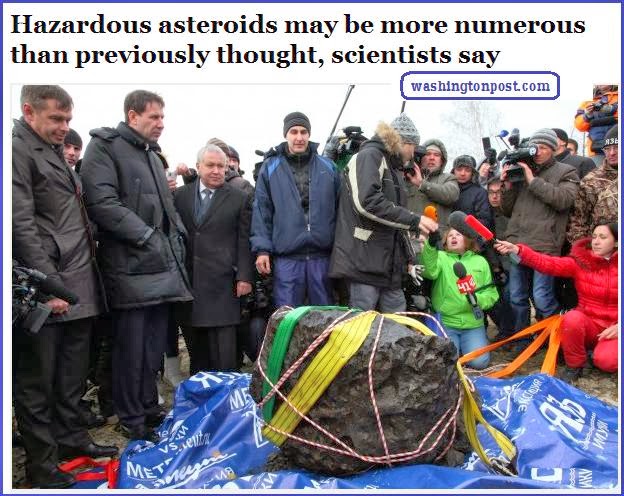
“The collision with the Chelyabinsk meteorite last year showed that space threats could be real and as destructive as huge fires or natural disasters on Earth,” Vladimir Puchkov said in an interview with Rossiiskaya Gazeta to be published on Tuesday.
The minister said a joint working group would be set up in the near future to develop solutions to counter space threats.
“The collision with the Chelyabinsk meteorite last year showed that space threats could be real and as destructive as huge fires or natural disasters on Earth,” Vladimir Puchkov said in an interview with Rossiiskaya Gazeta to be published on Tuesday.
The minister said a joint working group would be set up in the near future to develop solutions to counter space threats.
Ετικέτες
asteroid,
Chelyabinsk,
Earth,
espace,
meteorites,
planet,
Russia,
USA
Sunday, June 23, 2013
Russian Scientist Proposes Satan Missiles to Fight Asteroid Threats
YEKATERINBURG, June 23 (RIA Novosti) – Russia can use Soviet-era
SS-18 Satan heavy intercontinental ballistic missiles to destroy
celestial bodies posing a threat to Earth, a Russian scientist said on
Sunday, four months after a powerful meteor struck Russia’s Urals
region.
“Carrier rockets created on the basis of intercontinental ballistic missiles like Voyevoda [the Soviet name of Satan missiles], which use standard liquid fuel based on hydrazine, are well-suited for fighting suddenly discovered small [space] objects,” said Sabit Saitgarayev, a senior researcher at the State Rocket Design Center in the city of Miass in the Chelyabinsk Region.
“They [missiles] can stay in the condition of their readiness for launch for ten and more years, after some reequipping,” the scientist said.
“Carrier rockets created on the basis of intercontinental ballistic missiles like Voyevoda [the Soviet name of Satan missiles], which use standard liquid fuel based on hydrazine, are well-suited for fighting suddenly discovered small [space] objects,” said Sabit Saitgarayev, a senior researcher at the State Rocket Design Center in the city of Miass in the Chelyabinsk Region.
“They [missiles] can stay in the condition of their readiness for launch for ten and more years, after some reequipping,” the scientist said.
Subscribe to:
Posts (Atom)