Una gigante nube de desechos orbita alrededor de la Tierra. Desde piezas
milimétricas hasta satélites en desuso y etapas de lanzamiento rodean
el planeta.
Autoridades chilenas y miembros de un consorcio internacional que incluye a Australia, Brasil, Corea del Sur y Estados Unidos inauguraron las obras para construir el Telescopio Gigante de Magallanes, confirmando el norte de Chile como el mayor centro de observación espacial del mundo.
Les astronautes américains retourneront probablement dans leur segment de la Station spatiale internationale dès mercredi soir (heure de Moscou), a dit à RIA Novosti Sean Fuller, directeur des programmes des vols pilotés de la NASA en Russie.
Russia successfully carried out the first test launch of a newest heavy-class Angara A5 rocket on Tuesday. The
rocket was launched at Plesetsk cosmodrome in Russia's northern
Arkhangelsk region at 08:57 a.m. Moscow Time (0557 GMT), according to
the Defense Ministry press service.
Europe's robot lab Philae may not have enough power to send to Earth
the results of today's drill into the surface of its host comet, mission
scientists have said.
European scientists announced the historic rendezvous on Wednesday between a comet and the Rosetta spacecraft after a 10-year, six billion-kilometre (3.7-billion-mile) chase through the solar system.
The scout Rosetta has now become the first envoy to orbit one of these wanderers of the solar system in deep space, the European Space Agency (ESA) said.
Scientists and spectators at ESA’s mission control in Darmstadt, Germany, cheered after the spacecraft successfully completed its final thrust to swing alongside comet 67P/Churyumov-Gerasimenko.
Strictly in
line with the cyclogram (schedule) of the flight, 21 minutes after the
launch, the mass-dimensional model of the payload got to the designated
spot on Kura testing range...
Russia’s Aerospace Defense Troops have done the first test-launching of a
news Russian carrier rocket Angars-1.2PP, a spokesman for the Plesetsk
Space Center in northern Russia told ITAR-TASS. The launch was carried out as scheduled. The preparations and
effectuation were supervised by the Commander of Aerospace Troops,
Lieutenant-General Alexander Golovko.
The test launch of an Angara space rocket automatically aborted due to “technical issues,” Russian officials said. While the second attempt is scheduled for Saturday, President Putin has ordered the reasons for the launch failure be detailed in one hour. The launch of the Angara was aborted just few minutes before the start due to “technical issues,” sources in the Russian space agency Roscosmos said. The mission was aborted automatically.
Later this month the US Pentagon plans to award a massive contract to
one of the two most influential American contractors for a project
that, if all goes according to plan, will be able to identify space
debris before it becomes a threat to the Earth. Lockheed Martin Corp. and Raytheon Co. are competing for the $6
billion contract to design and construct Space Fence, a radar
system that will eventually be able to track large bodies of
space matter. The plan is being put into place so that the
government can not only better predict the bodies that may come
into contact with Earth (such as the asteroid that exploded over
Chelyabinsk, Russia, for instance) but also to better protect
satellites that could be destroyed while in orbit.
MOSCOW, January 27 (RIA Novosti) – Russian and US experts are
planning to join efforts in protecting our planet against thousands of
potentially hazardous near-Earth space bodies, Russia’s emergencies
minister said.
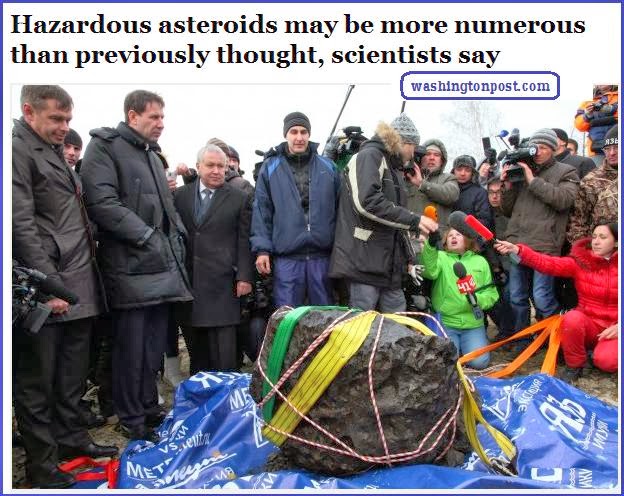
“The collision with the Chelyabinsk meteorite last year showed that
space threats could be real and as destructive as huge fires or natural
disasters on Earth,” Vladimir Puchkov said in an interview with
Rossiiskaya Gazeta to be published on Tuesday. The minister said a joint working group would be set up in the near future to develop solutions to counter space threats.
The European Space Agency (ESA) is awaiting signs of life from its
comet-chasing spacecraft Rosetta. The probe - now in the vicinity of
Jupiter's orbit - has been in hibernation for nearly three years.
An internal "alarm clock" aboard the Rosetta spacecraft was scheduled to
go off at 1000 UTC on Monday, waking it up from nearly three years of
slumber. But given the six hours Rosetta would need to power up its
system, plus the time needed for its signal to traverse the 807 million
kilometers (501 million miles) to Earth, the European Space Agency (ESA)
said it wasn't expecting to hear anything until the early evening.
Something must be done to deal with the estimated 100 million bits of
man-made space junk circling the planet, and Japan is taking the lead.
But can we do? Shoot it with a laser? Invent Wall-E-like robots to
collect it? Nah… let’s just blast a big net into space. Next month, Japan Aerospace Exploration Agency (Jaxa) will do just that.
Having teamed up with a company that manufactures fishing equipment,
Jaxa developed a wire net nearly 300 metres long but just a foot wide
that will be launched into orbit. Once it’s unravelled, the net will
generate a magnetic field that will theoretically attract nearby space
debris.
YEKATERINBURG, June 23 (RIA Novosti) – Russia can use Soviet-era
SS-18 Satan heavy intercontinental ballistic missiles to destroy
celestial bodies posing a threat to Earth, a Russian scientist said on
Sunday, four months after a powerful meteor struck Russia’s Urals
region.
“Carrier rockets created on the basis of intercontinental ballistic missiles like Voyevoda
[the Soviet name of Satan missiles], which use standard liquid fuel
based on hydrazine, are well-suited for fighting suddenly discovered
small [space] objects,” said Sabit Saitgarayev, a senior researcher at
the State Rocket Design Center in the city of Miass in the Chelyabinsk
Region. “They [missiles] can stay in the condition of their readiness for
launch for ten and more years, after some reequipping,” the scientist
said.
Depuis le début de la conquête spatiale dans les années 60, le nombre
de débris présents dans l'espace s'est accumulé de manière
quasi-exponentielle. Aujourd'hui une couverture de poubelle high-tech entoure la terre. Environ
deux tiers de ces objets viennent de l'éclatement d'autres débris
spatiaux : que ce soient des explosions ou des collisions. Comme celle
de 2009 entre les satellites Iridium et Cosmos à près de 800 kilomètres
au-dessus de la Sibérie. La taille des débris varie de quelques
millimètres à la taille d'un bus, n'importe lequel d'entre eux peut
abimer un vaisseau estime le chef du bureau des débris spatiaux de
l'agence spatiale européenne.